
(Click for the Presentation PDF)
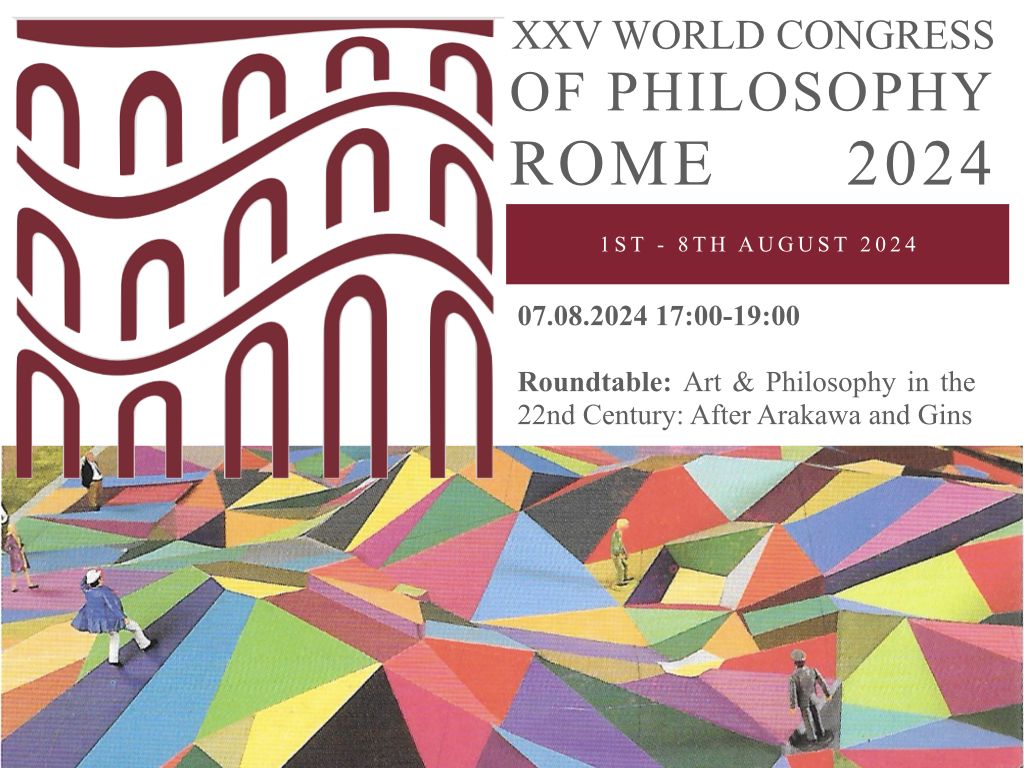
Dr. Alan Prohm (Berlin) – in the Roundtable Art and Philosophy in the 22nd Century: after Arakawa and Gins with Naohiko Mimura, Takeshi Kadobayashi, Renske Maria van Dam, and Alan Prohm at the 25th World Congress of Philosophy, Rome, Universitá la Sapienza – WCP2024 – 07.08.2024 17-19h
ARAKAWA AND GINS AND THE FUTURE OF PHILOSOPHY
Dr. Alan Prohm (Berlin)
Contents
- STORY
- CONTEXT
- APPROACH
- IMPACT
- RESOURCES
- BIOTOPOLOGY: A New System of Nature and of the Communication of Substances
- CONCLUSION
{Slide 1: Cover
INTRO
É con un piacere fuori di misura ma non senza una chiara e forte registrazione qui in questa mia presente materialitá – sapiente senziente – che mi materializzo stasera davanti a Voi, qui a Roma, insieme a questi miei laudabili colleghi.
Mille grazie alla commissione organisatrice di questo Congresso, alla Dr.ssa Flavia Palmiere, ed al Professore Naohiko Mimura per l’invito a partecipare a questo Round Table, sull’arte e la filosofia nel secolo XXII – dopo Arakawa e Gins.
La mia presentazione s‘intitula « Arakawa e Gins ed il futuro della filosofia » e continuerá in inglese.
{Slide 2: title (a)
The title of my talk is « Arakawa + Gins and the Future of Philosophy ».
{Slide 3: title (b)
{Slide 4: A+G
It begins with a story,
STORY
{Slide 5: Chapter A STORY
{Slide 6: 124W Houston St.
In July of 2011, I was in a sort of one-month mini-residency at the Reversible Destiny Foundation, staying in the 7th Floor loft at 124W Houston St. as Madeline Gins‘ and the Office‘s guest and participating in daily activities of the studio downstairs, while developing work and projects based on these researches, work and projects I continue to today.
{Slide 7: Arthur Danto
We (Madeline and I) were in a cab together uptown from Houston Street to somewhere Central Park East. We were invited to dinner at the apartment of Arthur Danto and his wife. (Danto was an important American philosopher, carrying a tradition going back through C.S. Peirce, John Dewey, William James (check) back into the Anglo-Germanic European streams of British Empiricism and Kantian critical rationalism). We were discussing on the cab ride uptown, and Madeline previewed to me a point she wanted to make to Arthur when we were talking later (and she did), namely, that the future of philosophy was architecture.
{Slide 8: M’s quote: future of philosophy
And, sure enough, after we had stopped to order burgers from an up-scale diner near-by and got let in by the doorman and rode up to the (?th) floor and met them and sat down and had dinner (hamburgers) at an elegant table talking all sorts of things, many of them threads of discussion already teased over the previous days at the Studio and later appearing in the texts of Madeline‘s (still unpublished) „Not if but When“, she did find her way to the line, „But, of course, Arthur, you realize that the future of philosophy is architecture, don‘t you?“ – To which Arthur Danto said, very dead-pan, „Oh, Madeline, I‘m pretty sure the future of philosophy is philosophy“. To which I like to remember Madeline replying, „How sad, Arthur. That’s too sad.“ But I may be paraphrasing that last bit.
{Slide 9: re-show A+G power twins: re-show A+G power twins
I wanted to tell you this story as a way of introducing you a bit further to Arakawa and Gins and to the future they saw for philosophy, which, to give it away with just one word at the start, was „architecture“. So, consider yourself introduced, this is Arakawa and Madeline on an afternoon in 2006, at their studio in New York, during an interview I was doing with them.
Engaging what these unique artist-philosophers could have meant by such a statement will certainly take us a step forward toward the future of philosophy. So, thank you for being here and taking this step with me. It should take us about another 10 minutes.
CONTEXT
{Slide 10: Chapter CONTEXT
Here is a little background before we can get in to trying to understand what this story means:
Q: What kind of architect/artists were Arakawa and Gins, that they would be eating hamburgers with a philosopher?
1st thing to note: they were philosophers’ artists.
{Slide 11: header philosophers‘ artists
A+G’s project of Reversible Destiny, which involved their particular kind of architecture (procedural architecture) was a material-philosophical project to stretch or overcome the limits of longevity, and it was an art project that came to have a particular interest for philosophers, out of proportion to A+G’s relatively low name-recognition outside of specialized art circles. This is a point made repeatedly by my esteemed colleague, Don Byrd, that to a surprising depth and degree, these philosopher-artists were philosophers’ artists. My friend (and theirs) Jondi Keane also went into this in depth in his 2005 dissertation on their work and thinking.* (*Jondi Keane, Arakawa and Gins: The Practice of Embodied Cognition; Dissertation Griffith University, 2006.
{Slide 12: name-cloud of interested philosophers}
Here is a slide of some of the philosophers who came to interact with A+G, in many cases far more involvedly than just the article or articles they dedicated to their work.
(Slide shows a name-cloud including Hans-Georg Gadamer, Charles Huxthausen, Werner Heisenberg, Hideo Kawamoto, Don Ihde, Italo Calvino, Marcel Duchamp, Giorgio di Chirico, Arthur Danto, Don Byrd, Erin Manning, Brian Massumi, Klaus Benisch, Jondi Keane, Reuben Baron, Jean-Jacques LeCercle, Jean-Michel Rabaté)
{Slide 13: Table
Harder to assemble but certainly interesting is the wider rhizome or constellation of contemporary and historical philosophers their work drew on or engaged, and the positions and relations their thinking holds with regard to these.
{Slide 14: quote Don Ihde
Expansive, intensive and daily readers, who conducted their business at a long table in their office with a vast library around them, they relatively rarely referenced other authors or sources and their books were not bibliographically indexed in conventional ways. The dialogues they are conducting with philosophical tradition or with new thinkers their contemporaries sometimes become explicit in their works (e.g. Rueben Baron, Dogen (and other Zen masters), and of course, Helen Keller, in Making Dying Illegal), but mostly they are dissolved in a background from which A+G write without footnotes, forming always new thinking from generally unspecified/unarticulated sources. (A section in my book project with Jondi Keane and Don Byrd, Another Kind of Knowing is devoted to teasing out this larger web of their philosophical affiliations and some of the present reflections will show up there.)
{Slide 15: quote Hans-Georg Gadamer about Arakawa (and Gins)
« An artist who sees spaces, walls and rooms as paintings and who sees paintings as walls and floors transforms the usual constancies of orientation into a strange-enticing game – a game of continually thinking out. One viewing this from afar, caught within the narrow confines of reproductions, can only begin to divine all that will get going there, what has been erected and spread out there. It is a uniquely astonishing event and it prods me to remember the verses of Paul Celan: ‘There are still songs to sing beyond the human being. » Hans-Georg Gadamer
{Slide 16: quote Hideo Kawamoto:
« Considering the conceptual similarities between autopoietic systems theory and the works of Arakawa and Gins, we can see how these works create sites in which we are called on to grapple simultaneously with the formation of the body and that of perception. Indeed, in the constructions of Arakawa and Gins, we often encounter exactly that place in which we are able to attend to the formation of perception and to the ways in which the body, through moving, forms itself. …
…the project of Arakawa and Gins operates at the highest level of the poietic sciences. » Hideo Kawamoto
{Slide 17: header procedural architecture
Q: So, What kind of architect/artists were Arakawa and Gins, again, that they would say such a thing to a philosopher? – In other words, What could Madeline have meant about architecture that could mean that about philosophy, that its future is architecture?
{Slide 18: House of Critical Resemblances – Yoro 1
A: The short answer is « procedural architecture »
{Slide 19: House of Critical Resemblances – Yoro 2
There is a lot written, yet to write and to yet to build about A+G’s very large and intricate body of work and thinking on this notion, “procedural architecture”. I and others have treated it in detail elsewhere*. For our purposes here, it is important to retain of A+G’s project that it is an approach to architecture that builds not for “functionality”, but for “procedurality,” as a value of intra-activation and vitalization in an organism (that persons)’s encountering the architectural surround. And, that it is there to do all it can do for the body, up to and not excluding overcoming mortality.
{Slide 20: Forms of Function
Interestingly and importantly, the focus they gave the question of their relation to the functionalist rationalist tradition in architecture in this text-image panel, prepared for the Guggenheim retrospective in 1997(?) (here in my digital reproduction), is the ability of procedural architecture to more promisingly pose unanswered (or still inadequately addressed) philosophical questions, in their case here, « determining the extent of the site of a person ». – We’ll come back to this.
APPROACH
Without some kind of clue or hint it may be hard to know how to approach these artists/thinkers. How can we approach making sense of this statement of theirs? A few commonplaces might come to mind:
e.g. Geometry – isn‘t geometry classically (since Aristotle or Euclid) the model for proof-construction in logic? Is that relevant?
e.g. Topology – isn‘t topology essential to the solution of higher problems in math, in cosmology and in philosophy of mind – since when, …?, Riemann, Euler, Leibniz?
Are these architecture? Aren’t these architecture?
Certainly this is:
e.g. Built sites of daily research
Aren’t philosophies always rooted in original spaces, built or habited sites, what A+G would call tactically posed surrounds/tutelary abodes and sites of daily research?
Can’t we think of a long list of architectures of various orientation that have proposed or really become, the future of philosophy (sacred grove, Akademia, Lykeum, the Library of Alexandria, the House of Wisdom in Bagdad, Damascus, Cordoba, Mallorca, …, Naples, Paris, Hannover/Berlin; … ); … isn‘t what you are looking at when you are looking at the Platonic injunction (gnothi seavton – know yourself) actually the entry arch or keystone of the physical akademia that stood in Athens and where Aristotle actually attended the lectures of Plato (who himself had sat and walked about (peripatein) with Socrates in the sacred groves and his … ), before himself (Aristotle) setting up on site at his Lykeum to conduct daily inquiry? Didn‘t the flame of this inquiry rekindle in Bagdad in the 9th Century with Al-Kindi in the House of Wisdom he was entrusted with running, translating and advancing reflection on the soul, the world and everything, mirrored in the 13th Century at the far end of the great lens of the Mediterranean in the mountaintop St. Ana monastery of Ramon Llull, whose best student 300+ years later was Bruno, whose best student 50-60 years (Paris years) later was Leibniz? And on the other side of the archway, or was it another archway into Plato’s academy was reportedly written, « Ageometritos mideis eisitó – May no one without geometry pass these gates » So we’re back to the start.
IMPACT
{Slide 21: Chapter IMPACT
I want to say something about the impact A+Gs work and provocations can be seen to have on philosophy.
The claims A+G make with their architecture apply an immediate stress to thought, not only generally to presuppositions of human common sense regarding mortality, but also specifically to key anchor points in how we generationally have endeavoured at constructing truth and some kind of certainty in what we call Western Philosophy, from Aristotle’s foundational syllogism “All men are mortals. Socrates is a man. Therefore Socrates is mortal.” (*the actual Greek is different: …), to Heidegger’s lamentable late modern re-positing of this philosophical defeatism in his notion of Being-towards-Death, a horror of logic A+G refused to perpetuate.
{Slide 22: We Have Decided not to die
The claims, whether tossed provocatively as barbs of thought in a dinner conversation, spread on the title of a major retrospective exhibition catalogue or built as elaborate architectural environments complete with instructions for use, have explosive implications. In my paper for Prof. Mimura’s AGxKansai conference in Japan in 2022, I spoke about the claim-making in A+G’s intellectual and constructive practice, a characteristic of their pedigree as avant-gardists (Arakawa came up in Neo-Dada activations in Japan of the early 1950’s), conceptual artists,* (*Arakawa came to New York with the personal encouragement of Marcel Duchamp, and as for Madeline, she was both one of the most original conceptual writers of the late 20th C and one of the few to bypass the collapse of experimental poetry into concept art with the LANGUAGE movement). Also one that places them in a tradition of provocative and performative thinkers (think Diogenes, think Giordano Bruno).
I see three basic claims or stages of the claiming underlying Procedural Architecture:
{Slide 23: 3 Stages of the claim}
1- that architecture can and must pose (to better answer) philosophical questions
2. that architecture activates/extends/creates the body of its perceiver / participant / user
3. that architecture can reverse destiny – or mortality
The claims bring a vision of radical embodiment, of intra-subjectivity between person and environment, of indistinction between meaning and mattering as processes in nature.
By the time of their 2006 publication, Making Dying Illegal, they had boiled it down to three hypotheses, the « Three Hypotheses of Procedural Architecture »:
{Slide 24: 3 Hypotheses of Procedural Architecture 1
{Slide 25: 3 Hypotheses of Procedural Architecture 2
1 – Architectural Body Hypothesis or Sited Awareness Hypothesis
What stems from the body, by way of awareness, should be held to be of it. Any site at which a person deems an X to exist should be considered a contributing segment of her awareness.
2 – Insufficiently Procedural Bioscleave Hypothesis
It is because we are creatures of an insufficiently procedural bioscleave that the human lot remains untenable.
3 – Closely Argued Built-Discourse Hypothesis
Adding carefully sequenced sets of architectural procedures (closely argued ones) to bioscleave will, by making it more procedurally sufficient, reconfigure supposed inevitability.
{Slide 26: IMPACT graphic
It is my claim, that the implication-vector of these claims, compounded by the explosive and corroisive potentials it uncovers on its way back through the background of philosophy, ground after ground, reactivating old matter in the re-opened ground of each age’s orthodoxies. Philosophical history, not yet to speak of its future – but we begin to see the potentials – is shaken, axiomatically destabilized and rendered tentative again, no longer « so damn sure of itself », with new potentials open to recombination and new positionings. I hope to provide some detail here to back up this claim.
RESOURCES
{Slide 27: Chapter RESOURCES
What resources were these in the background of philosophy? And where does this all come from? Is this impact I am describing an impact they were intending? What were they thinking? Who were they thinking this with? And what makes them, or anyone, think what they are proposing could work?
I said A+G were philosophers’ artists, but who were their philosophers? They made uniquely rare reference to other texts or thinkers in their writing, and their books for the most part are not traditionally annotated or indexed. So some archeology is required. Consider this a contribution to the archeology of another kind of knowing, and of the past of philosophy’s future.
In numerous comments, like some I recorded in interviews, Arakawa had the habit of throwing it all back to some time, some turning in the 16th or 17th C.
{Slide 28: Arakawa quote and recording – play clip from Soundcloud
Arakawa: „One reason historically speaking, tentativeness’s history is so mess, so sociologically, philosophically, people made, they didn’t …, and made any tentativeness, any a, a, I should say, anything you could make abstractions, they cut off every important part. That’s why science and philosophy and art have become so rigid in the 20th C. I’m sure, at the beginning of the 17th Century, people were fighting about that for half a century, which way to go. / … / Madeline: But at their time their tentativeness is marred in a different way. …/ Arakawa: They always kept, they’re looking for eternal conditions, or this what they call, something forever, anything in this world, this is 20th Century, 19th Century completely they forgot, that that’s the invention of the so completely ingored this living, this, (Min Full length: 0:00 – (0:38-1:23) – 2:31) stupid so-called mind or consciousness – and they completely ignored this so-called, this living organism, you know what I mean? – that’s the most important name. Everything unknowable, impossible to know, spiritual and all the ideas and things. That’s what’s this between. Look at them. We are now…. Madeline and I, we are trying to, just every inch of this tiny, this fact, we are pointing out. That’s why we need some million questions, like over 2000 years….“
Some logical guesses for making sense of Arakawa’s statement come to mind. What was this turning? Very generally, the age of reason and the dawn of modern science? More specifically, perhaps, the setting in of Cartesian rationalism, on many levels unshakeable to this day? These are likely guesses. That this turn might correspond with the moment of occultation of Leibnizian non-duality in the establishment of the European Enlightenment tradition? This might come as more of a surprise.
{Slide 29: Architectural Body covers
This (on the right) is the back of their 2002 publication, Architectural Body, tour de force manifesto or program of procedural architecture and A+Gs reversible destiny philosophy. No footnotes or bibliography, but there is this list on the back where jacket blurbs would usually appear, with the heading: Background.
{Slide 30: detail of Background list: Dogen and Leibniz
They list Dogen, Leibniz, Alexander Pope, Mary Shelley, Arthur Rimbaud and Duchamp. Let’s look at Leibniz. The only undisputable, Western-brand philosopher in the group, in surprising resonance here with the great thinker, Dogen, who was also a Zen master, a meditator and a poet.
A+G’s direct reference with Leibniz in this list is to his « Drôle de pensée » text (« Drole de pensée, touchant une nouvelle sorte de representations » 1675.) This text is a favorite where I come from, namely Berlin, and in particular the context of media for museums and exhibitions, where many exhibition creators are inspired by its vision of a museum of a very different kind. It projects a culture of knowledge production by our standards today still creative- and innovative-, collaborative/interactive, vastly interdisciplinary and multi-medial, even anti-establishment-sounding, though he as a thinker was both a grounding influence behind the Berlin museum landscape as a showcase of knowledge about world cultures and behind the foundation of the Berlin Brandenburg Academy of Sciences in 1700, and a presence behind the concept and creation of Wilhelm von Humboldt’s new (in 1822) university in Berlin.
Even more profoundly, however, from my point of view, in referring to Leibniz on the back cover of this book, A+G are calling on a vital figure in the evolution of German (and by descent, influence and correlation) European philosophical history. A transfer node in global wisdom traditions. Leibniz is the key modern figure because he played the role of thinking Spirit back down into Body after the end of theological hegemonies. He is often described (a panel I attended on Sunday was an example) as bringing God back into the equation to round out his cosmology against mechanistic reductionisms. But I think we do better to understand him as emptying the last of theology out of his world-modelling. Not by rejecting or leaving God out, but by accomplishing the abstraction necessary to complete a switching-point in Western intellectual epochs, with transfer of the semantic import of the word Ésprit (Spiritus) from „Soul“ (Anima) to „mind“ (Mens). That is, I see Leibniz as landing the arc of Western metaphysics back in a non-dual cosmology and philosophy of relation above distinction in the materiality of mind, after centuries of knock-on in the ancient arguments between aristotelians and platonists, including the centuries of catholic aristotelianism that perceived God at the heart of all explanations and established a culture of thinking bodies without organs. While Leibniz is abstract and pious enough in his writings to deserve some of the criticism he gets, the non-dualism he posited and insisted on converts any apparent spirituality into a highly rarified materialism of mental activity and the mechanism of making sense of the world through its inputs: acts of sited landing called awareness.
{Slide 31: quote Leibniz « mon système
…mon système, qui conserve la force et la direction, et en un mot toutes les lois naturelles des corps, nonobstant les changements qui s’y font en consequence de ceux de l’âme.
I think with this we can already see that there would be a sympathy and interest with Leibniz, but how does this reflect the radicality of the claims and implications A+G’s project brings into play?
It comes down to how these positionings and positings open the rifts and gulfs they open in the philosophical tradition, particularly the long and scattered history of reception of Aristotle’s de Anima and the occlusion of embodiment/embeddenness/enmeshment in the world-constructing (physics + the geometry to measure). The established groundings of philosophical discourse in our age and key previous ages are shaken and dissolved by contemporary (future-defining) science and psychology, but they were already shaken and confronted with corrossive antedote to their critical categoriality by Leibniz, Kant’s predecessor, who may come off as more religious than Kant but, in fact, is the more embodied and the more materialist of the two.
{Slide 32: Leibniz quote « Who reports the changes in the body to the mind? »
This is the point of Leibniz’s attack on Descartes. He reproached Descartes for taking a reductionist (uncritically Euclidean) geometry on top of a reductionist (mechanistic) physics as bases in constructing his model of knowledge, reasoning and proof-construction. This worldview only sees, and only needs to account for, mass and velocity, cutting force (the cause of movement in bodies) out of the picture and of the equations by metaphysically punting the question of causes out to an omnipotent/omniscient God, cause of all things. He ridiculed the position cartesian thinkers of his day put themselves in (called « occasionalism ») calling Deus ex machina to justify their reduction of theoretical scope to efficient causes (in the 4-fold scholastic schema of causality: material, formal, efficient, and final), with final causality outsourced to God – and this, at every juncture, that is, every event at every scale of action has to be seen as being caused individually and freely – not all at once, under a global order or commandment (God doesn’t subject itself to constraints or commandments) but, as final cause, occasions each event everywhere forever. Leibniz found it more elegant to think there was force in matter (« no bodies without movement, no substance without effort ») and hence direction, motivation and directedness.
In his essay « Tentamen Anagogicum » from 1697, Leibniz gives this distinction between two kinds of thinking, two models and projects (his word is regimes) of thought, perhaps its sharpest formulation, distinguishing between a « reigne de la puissance » or « regime of force » where things are sufficiently explained by their efficient causes and a « reigne de la sagesse », or « regime of wisdom», where everything can/must be explained architectonically, so to speak, consistent with final causes.
{Slide 33: quote règne de la puissance
..règne de la puissance, suivant lequel tout se peut expliquer mécaniquement par les causes efficientes, lorsque nous en pénétrons assez l’intérieur; et aussi le Règne de la sagesse, suivant lequel tout se peut expliquer architectoniquement, pour ainsi dire, par les causes finales, lorsque nous en connaissons assez les usages. « Tentamen Anagogicum (Essay on the Supreme Cause)» (1697), in Système nouveau de la nature et de la communication des substances, p. 96 (p.103/104)
This règne de la sagesse, the architectonic explanation of the world consistent with final causes, accounting for the value force, which ultimately comes down to a life force, I will claim, is precisely what gets blacked out, reduced out in the black-box of positivist, objectivist, rationalist conceptions of and efforts at knowledge, of the Cartesian/Euclidean rationalism that set in in the 17th Century and has been hard to get past since. It is characterized by a side-stepping of the animate, motivated dimensions of bodies and their role in the construction of knowledge, proof and truth and the effective exclusion of these from the calculus. (cf. Barad p.205, cf. Wexler?)
So, in our little archeology, I think we have found something: Leibniz proposes in the place of Cartesian mechanism a living physics of immanence, where everything can be explained in relation to its architectonic siting/emplacement/embodiment in a perfect harmony (where perfect does not mean anthropocentrically agreeable, but rather that every interval, link and gap is accounted for and potentially expressible according to the system, what Leibniz calls, with the title of his important 1695 treatise, a New System of Nature and the Communication of Substances*.) (*Sounds like Biotopology to me.)
It was Leibniz’s desire, by means of an all-encompassing formalism (caracteristica universalis) to tune philosophy such that the gaps and blindspots of a Cartesian worldview would all disappear (like smoothing the step problem in calculating the path of movement along a curved surface). And it was his perfection of the theory of infinitessimals (infinitessimal calculus) that underwrote his positing of the preestablished harmony. In other words, for all of the mockery* (*e.g. by Voltaire‘s in the satirical character of Pangloss in Candide (1759) , the preestablished harmony came down to the infinitessimals, and therefore never does « come down » in the sense of landing or ending. The discourse of force and substance calls out (and back to) the long Aristotelean tradition engaging the notion of entelechie and the form-force of inhering identity, but at the same time it is introducing an effective solvent into the ground of modern Western philosophy built on Aristotle, built on Descartes, built on Kant, as if there were ground there, when in fact it was establishing a trend to the ineluctable (but not irreversible?) ungrounding of philosophy in the abstractive circuits of logo-centric rationalism.
{Slide 34: Leibniz Analysis Situ 1
{Slide 35: Leibniz Analysis Situ 2
As is warranted of an exciting dig, there is another surprise below the surface on the topic of Leibniz, listed among choice others as background to their theory of the architectural body. Because, in Leibniz‘s more obscure mathematical texts (in particular, in the drafts and letters collected under the title Caractéristique geometrique) we find treatments on geometry of remarkable relevance, under the rubric of an « analysis situ » or analysis of site or situatedness, often translated, a little misleadingly, as situation. This brings Leibniz’s search for a broad theory of relationality (e.g. in the Monadology) to another level of concretion and specificity, in the attempt to formalize his vision of a calculus of situation based not in measure as quantitative value but in distance as a quality of a body’s immanence in world.
{Slide 36: Leibniz Analysis Situ quo
At first, and second glance, this formalism seems strikingly in line with the kind attempted by the artist/thinkers A+G in diagramming landing sites, e.g. the various series of «charts» exhibited with the 1991 Constructing the Perceiver exhibition in Tokyo and Kyoto (and published in the catalogue: Constructing the Perceiver — Arakawa: Experimental Works, National Museum of Modern Art Tokyo, 1992).
{Slide 37: close up diagrammed body
That is the sense of these dotted lines, each time the casting forth of landing sites. A+G’s formalism (based on a conceptual system that evolves over time) evolves over time; here we see L’s for localizing landing sites, and V’s for visual perceptual landing sites, later they use „dimensionalizing“, later „architectural“, … . In fact, it comes down to a rewriting of geometry around the radically reduced set of elements: points of attention and the distances between them.
As an advance on and critique of reductionist geometry and constructions of truth and the project of science, Leibniz’s analysis, not to mention further developments in the formalism with Euler, Gauss and beyond, demonstrates no doubt a profitable resource for undertaking the formalism of an art-science theory-practice A+G will call Biotopology.
{Slide 38: Chart of resources (a)
In Leibniz, A+G find:
1 – a serious, rigorous engagement around the premises of mind/body integrity and non-duality
2 – a globalization of this conception of animated matter to a new model of the world incl. force and drive together with a purely abstract theory of space
3 – the basis for a formalism – diagramming and draughting – body-env relationality
Entering the field they (A+G) entered (procedural architecture) and coordinating practice through theory there, they drew on a rich, wide and a little bit hermetic range of sources and experiences to establish a unique position/displacement in the philosophical tradition, engaging core debates from what they saw as a critical juncture at the setting-in of logo-centric modernist rationalism, which I cast here as before and after Leibniz (building on Pascal (and less openly on Giordano Bruno) to counter Descartes and the Cartesians) with a vigorously plenist and intensively intra-active, material-aesthetic epistemology, a kind of knowing of within/not without, one that refuses reductionist mechanics and geometry (Bruno: „Aristotle is the God of geometers.“), in favor of an architecturally embodied – “architectonic” “new system of nature”, resonant with the universal harmony of Leibniz, w/ Pascal’s sagesse and finesse rather than justesse, with the ultra-plenist and amor-immanent “nolana filosofia” Bruno birthed and burned for, with certain intuitions of Xenophenes still challenging Aristotle, with surpluses from Al-Kindi’s reading of Aristotle, inherited up through Al-Farabi and then Avicenna to be lost again with Averroes (check); found again a bit further in the mediterannean drift of this history, with Llull on Mallorca, and so also by that way on to Bruno, and on to Leibniz, who read both Llull and Bruno (as much as there was of them around at the time), at the threshold to this our current, best, almost could-have-been-current kind of knowing. Let us at least track what might have gone lost or can be finally dis-/un-/covered of the body’s inherence and implication in univers-ing.
/
Similarly, for Dogen
{Slide 39: Chart of resources (b)
For the same characteristics and others, A+G’s theory and practice are resonant with the dissolving ontologies of Buddhist (Vipassana, Abhidhamma, Zen) philosophy. Arakawa’s philosophy of the Blank materializes as an architecting of embodied fullness for an “even more” of the total life force (bios, cleaving) factored in to the cause and course of movement and matter in a world unseparable at that seam. Dogen’s Mountains and Rivers, Dogen’s „walls, tiles and pebbles“ are mind and vice versa. Architectural Body is a commonplace of the position of body-mind integrity – points to an integrative solution to Western logo-centric rationalism’s many pitfalls and errors of thought. (* ref. Sansui-kyo „Mountains and Waters Sutra“ and Shinjin Gakudo „Body-and-Mind Study of the Way“ in Dogen, Moon in a Dewdrop: Writings of Zen Master Dogen, ed. Kazuaki Tanahashi, North Point Press, 1985)
(to develop in the book, Another Kind of Knowing: on Arakawa and Gins)
/
Similarly for Bruno
{Slide 40: Chart of resources (c)
(to develop in the book, Another Kind of Knowing: on Arakawa and Gins)
{Slide 41: Chapter BIOTOPOLOGY
BIOTOPOLOGY: A New System of Nature and of the Communication of Substances
{Slides 42-65
What A+G make of this sourcing, this holding in place for tentative constructing, is best assessed around their construction of Biotopology, both as built theory and as prospective research. I have already provided a few guiding definitions.
When A+G published Making Dying Illegal with Roof Books in 2006, arguably the most independently substantial section of the book,(though it turns up almost incidentally, as an attachment among others within an email exchange with two unknown scientists), was the treatise introducing the new “artscience” of Biotopology* (* this section from my review of Making Dying Illegal, 2006). A metatheory grown from their spatialized model of awareness based on landing sites, biotopology is named and articulated here for the first time as a practical, counter-reductionist epistemology of tentativeness, a pragmatics of “knowing and non-knowing”, and as the mode of thought most conducive to the recommended goal of living as an architectural body. In it we recognize the phenomenology of diagrammatic awareness-tracking that underpins their work, both their theoretical search for a way to intervene in the body-cognitive processes that shape a world for a self and decide their limitations, and their practical search for the experiential leverage that might be applied (principally through architecture) towards a reconfigured mode of being. As theory, however, the leverage biotopology itself exerts here takes the form of language, language concepts to support awareness and reorganize thinking.
The reconfiguration at issue in biotopology reveals itself to be in line with several generations of effort to allow certain profound consequences of modern physics (and of more recent cognitive science and biology) to work their way through into our operative self-/nonself-understanding as individuals and as a species. Put one way:
“Biotopology does away with the discrete object….” (74).
Learning to see/think with any degree of the complexity which relativity, quantum or complexity theory have shown to be the case, and escaping the apparent and devastating pitfalls of reductionist thinking in human and world affairs, is no easy task. In the 1940’s the designer Moholy-Nagy saw the link between social catastrophe and the bad habit of thinking in what he called “object concepts”, and in the 80’s the physicist David Bohm proposed the “rheomode” as a point of linguistic reform for addressing just this problem. Gins and Arakawa’s cleaving, Bioscleave and architectural body are concept proposals in this tradition, so in-between and in motion they resist our inevitable effort to think them as objects. And with the treatise on biotopology we now have two higher-order conceptual tools, the approximative-rigorous abstraction and the terminological junction. Presented as conceptual/linguistic strategies to allow thinking to proceed in the face of undecidability, where terminology-as-usual would kill the object of investigation by pegging it as an object, they are also very informative about the artists’ own idiosyncratic and often perplexing language use:
Approximative-rigorous abstraction, e.g. “cleaving”, “landing site” or “architectural body”: “holds open and continually keeps posing the question of what is it that in its name has been and is still being abstracted. It is an abstraction that has a reference realm that stays loosely and widely defined even as it is presented in sharp focus.” (57)
Terminological junction, e.g. “event fabric/landing site configuration” or “organizing principle/allowing tendency/axis of possibility”: “an important means for keeping vivid the multiple scales of action that are in operation as the world.”(61) “A terminological junction will loosen concepts or unwind them even as it acts as a means of pursuing them to the bottom of their implications.” (74)
CONCLUSION
{Slides 66 -70
To write poetry after Auschwitz: Barbarism. To do philosophy as usual after Hiroshima and Nagasaki, similarly. A+G’s architecture, pitched to Arthur Danto as the future of philosophy involved an explosive NO! in the 20th Century to a legacy of knowledge practices dominating since somewhere in the 16th/17th Century. And an infinite YES! to propositions, some long lost in the cleavages the tradition emerged from, some, with A+G, “new to the 21st Century”, of affirming and, why not?, extending human life!
The philosophy of the future, finally post-Kantian (post-Cartesian, post-Aristotelean), post-phenomenological, post-poststructuralist:
kinaesthetic tacticality-centric (rather than logo-centric) intra-rationalism – based on everyday research in tactically-posed surrounds/tutelary abodes/bioscleave
The „extent of the site of a person“ is precisely the thing about architecture (also about the person) that geometry cannot measure and logocentric rationalism cannot think, the remainder of body on logo-(numeric) reductions. An architecture set up to ask these philosophical questions not only posits new concepts – it transposes the positing into a (vastly) alternate modality – in which thinking fundamentally engages other modes of (claim to) efficacy. Just as Leibniz’s infinitessimal calculus (filling the gap on conventional Euclidean reductionisms) improved the geometry of curved surfaces by overcoming the stepping effect of rougher approaches, A+G’s exhaustive, procedural and reversible destiny architecture will produce improvements in the calculus and measurement of person-architecture intra-activity by adding in layer on layer of landing and imaging between any two steps in any process, otherwise reductively described.
Essential to the biotopology they call upon to fill out our knowledge-from-within of the intra-activity they define as the field of thinking, is diagramming – biotopological diagramming. But beyond the post-structuralist diagram theory of deconstruction; biotopology comes to diagramming in the bioscleaving activity of organisms personing encountering architectural surround. The difference between diagramming like Eisenmann reads out of Deleuze for poststructuralism and the Biotopology of A+G is, besides the real surpassing of logo-centrism in the reasoning, the tight tying of characteristic modes of functioning of imaging into the perception-action/intra-activation cycles, where Bios, life, is inexorably, immutably in the equations.
So, if in the end(less), philosophy will be architecture, of what kind(s) of philosophy will this architecture be the future?
- practical philosophy of the good life in ethical harmony with a physically mastered world? – one capable of changing fates, increasing life, longevity and liveliness? – one like Kant’s Reason capable of keeping world peace, one like Aristotle’s of the good man in the Nichomachean Ethics, of the virtuous and judicious man of Al Farabi?
- Certainly and explicitly, their philosophy, conducted in (among other kinds) built discourse, is a « crisis ethics » and inscribes itself at the undistractable present of the ever-current urgency – not to die.
- I think we see most clearly when we see a philosophy of education and for the raising of children – jumping from an « if you study and obey reason you will in all probability not have war in your time » (Kant), to an « if you develop the full range of your personality, you will be fulfilled and free » (WvHumboldt), to an, « if you suppress the demands of individuality and conform to imposed national-genetic identities, you will in all probability win your world war » (Hegel), to an « if you study hard and learn all there is to know about the body, you will in all probability not have to die » (A+G).
And, as Hans-Georg Gadamer commented, on first learning of the work and ideas of A+G: reminds me of Celan’s line, « there are still songs to sing beyond mankind ».
{Slide 71 – Thank you
THANK YOU
______________________________________________________________ END
 PROCEDURES Journal