

DON BYRD – Title: A RADICAL REORDERING (OF, WELL, EVERYTHING): Notes toward a Book to be entitled, Another Way of Knowing
Text of DON’s presentation
Gins and Arakawa met in 1963. Soon thereafter they established a domestic
relationship and a coordinated artistic practice that was based on a strong, perhaps
desperate, premise. They never wanted to box themselves in, but they might have said
something like this:
Everything we know, including the proposition ‘everything we know is wrong,’ is
wrong.
Beyond that, they entered into a space where propositions are judged not in
relation to given facts and self-evident axioms but in relation to their consequences.
We are beyond the end of history. The complexities to be solved were not known
before the middle of the last century and to return to our deep history is only to find again
the forms and stories that are the roots of our problem.
My presentation is entitled
A Radical Reordering (of, well, Everything):
Notes toward a Book to be entitled, “Another Way of Knowing
Madeline and Arakawa did not offer a revision of the classical philosophic
tradition and its underlying human abstract. This other way of knowing belongs to an
entirely other topos or research site, and its questions belong to another, more intimate
scale. Reversible destiny deals with matters relevant to evolving, complex earthly
intelligence.
Formal, human knowledge deals in generalizations. It states what can be shown to
be and leaves us to deal with it. It is a remarkable kind of knowing. It would be useful
knowledge, for example, for creatures who do not change.
The human operating system or HumOS–the grand knowledge in which we are trained, beginning when we are taught to speak by human families and human communities–teaches us to describe the given world and determine which descriptions are generally true. These descriptions belong to different and symmetrical scales: the cosmic and the social. Theoretically, they are distinct. In practice, they are twisted in an ugly knot.
The Mechanism of Intelligibility negotiates the treacherous distances between
these two scales in absolute terms. The human knowledge workers are the custodians of
the that maintains the normative zones. The Machine, however, does not, tell the humans
how to use their knowledge, or how to dispose themselves in relation to it, though
dispose themselves they do.
They are often surprised.
Ordinary human life is on the bumpy road between physics and metaphysics. This
wilderness of becoming paradoxically exists between the being that has forever existed
and the being that will have forever existed. The space between being as history and
being as prophecy is a wild and dangerous place. The kind of place marked on ancient
maps, “Here be Dragones.” The evolution and survival of complex intelligence takes
place forever where there are Dragones.
In the Preface to the 1978 edition of The Mechanism of Meaning, Madeline and
Arakawa say, speaking of death in the way young people speak of an art movement of an
older generation, “Death is old-fashioned.” And they go on to ask, “Why has history been so slow?
Was there something wrong with the way the problem was pictured? What if thinking
had been vitiated by having become lost in thought, for example?” And they complained
that there did not yet exist even the most rudimentary compendium of what takes place or
of the elements involved when anything is ‘thought through.’”
What does it mean to think a thought through? Beyond its halfwayness. To think it
all the way through to its meaning.
It is generally a mistake to try to explain a joke, so I will explain another joke in
its place, or perhaps it is not a joke:
The HumOs is wondrous and awful– ‘HumOS’ sometimes rhymes with cosmos,
sometimes with chaos, and its world is structured by universal equilibrium or harmony.
The human abstract or soul is so inclusive and grand it can account for the fundamental distinctions–cosmos and chaos, subject and object, and life and death– understanding one side of the distinction in terms of the other. The Mechanism of Intelligibility thinks itself into being, according to the philosophical account, from nothing. It thinks halfway through its thought of itself and then thinks its way back, as different but the same, making itself whole again.
There is something wrong in this hall of mirrors. The mechanism of intelligibility generalizes the universal abstraction as three concepts, different and the same: the universal three-in-oneness / one-in-threeness–
The thing,
the other thing,
and the medium that returns the one to the two.
These slippery concepts are defined in terms of the many that are one; the discrete
manifold that is also continuous, and so forth. Pluralism = Monism. It is the illusion of
the multiplicity that is continuous.
The structure, which was common in early mythology, prevailed from the
Pythagorean family romance that Plato appropriated in the Timaeus and through the
Augustinian trinity, the mediating forms of the Cartesian pineal gland, the dialectical
thirds of Hegel, the ontological triad of Peirce and to the early cyberneticists and the
recent apologists for the contemporary mathematical synthesis. One, two, three, one,
three, oom-pah-pah; it is waltz time.
How do two brilliant young people inclined to philosophy and comedy cope with a
world that is unfathomably complex, intelligible only in pieces, absurd, and dangerous?
Madeline and Arakawa set out to break the habits of life and death. At least to take
the habitual world system in hand and give it a shake.
They were comic artists. They reclaimed their innocence as Earthly creatures.
“Every post-utopia would call forth, for the sake of a working out of the details, its own
utopia. This would be a garden of Eden of epistemology, and more….” (The Mechanism
of Meaning, 1988)
They counted beyond three, beyond the human triad: one, two, three, four, five,
six. They entered into physical contact with the environment, and the Mechanism of
Meaning appeared.
Madeline and Arakawa take up history not as a continuum of ritual and repetition,
but as the present in the movement of a trajectory. History is the engine of the mechanism of intelligibility. It delivers us here and, above all, now. They think of themselves as
artifacts of history in need not of explanations but plans of action. Their intention is not
to understand or to adjust themselves as ontological creatures. The principle of action that runs through their work can be stated thus:
Always act so there are more ways to act next time. If more possibilities of action
are used up than are generated, the system fails and the evolving system dies.
The Mechanism of Meaning is devoted to the creation of ways to act next time.
Their work has to do with the creation of landing sites.
In 1988 they wrote: “…it is the entire situation, everything a person has at his/her
disposal that we want to build, and so we must think in terms of nothing less than a
model or field of sensibility. We use a number of new terms to engage the determinant
events of a ‘thinking #.’” They foresaw an “epistemological paradise.”
It seemed for millennia that the HumOS was self-creating and self-regulating, but a
surprise lurked in human history, and by the 1960s, the human abstract and its apps had
slipped over a threshold.
The self-referential protocol on which the system had depended for equilibrium
revealed the viciousness of its circularity.
There were too many and too much of everything– too many people, nuclear
weapons, cars, poems, scientific theories, and televisions; too much solid waste and
carbon emissions.
Of course, the resources were too few.
The dire reality of the Anthropocene had not been named, but it was revealed or
beginning to be revealed.
Einstein and Duchamp stand for Madeline and Arakawa as the representative
figures of the mechanism of intelligibility–the one as the image of its success, the other
as the image of its remarkable and, in some way endlessly attractive, failure. Duchamp’s
mechanism of intelligibility is perfect because it does nothing.
Einstein, who figures centrally in one of Arakawa’s important early pieces, was
among the last of the great classical thinkers, and the classical dilemma was never clearer
or more poignant than in his life-long intellectual project: he assumed an entirely
canonical position in which one sought literally to destroy oneself with one’s knowledge,
to make oneself a trivial subroutine of the cosmic machine : “Man seeks to form for
himself, in whatever manner is suitable for him, a simplified and lucid image of our
world, and to overcome the world of experience by striving to replace it to some extent
by this image. That is what the painter does, and the poet, the speculative philosopher,
the natural scientists, each in his own way. Into this image and its formation he places
the center of gravity of his emotional life, in order to attain the peace and serenity that he
cannot find within the narrow confines of swirling personal experience.”
Einstein’s project was consistent with the advice that the Archangel Michael gives
to Adam and Eve in Paradise Lost as he conducts them out of the Garden of Eden “to
build a paradise within,” and it was consistent with the subjective philosophies of
Descartes, Spinoza, Kant, and modern, organic philosophy on which Einstein drew.
The lucid image and the swirling personal experience are different, but ultimately
each are equivalent to totality and, thus, substitutable one for the other. There is
something fishy about this. Ungainly caprice or randomness appears in the place of the
logos.
This is not to say that the relativity equations do not describe important aspects of
the natural phenomena or that Joyce’s Ulysses is not an aesthetic masterpiece but that the image of the world that derives from them can serve in the place of swirling personal
experience only to the extent that one withdraws to the Philosopher’s Garden or the
Institute for Advanced Studies, some rarified and commodious place of decontextualized
and timeless concepts.
Madeline and Arakawa undertook the task of returning the paradise within, if it
was paradise, if it was within, to the Earth.
Arakawa’s performance work gained him notoriety at an early age and a series of
sculptural pieces that resemble open coffins established his reputation. The best known of these pieces, Einstein Between Matter’s Structure and Faintest Sound, names a gap in an
unknown geometry that extends from the given stability of generalized, spatial concepts to the randomness of the perceived world. The more one looks at the work the more
uncertain and interesting this gap becomes. It is a place fraught with uncertainty, from
which it is perhaps possible to create not images of a given reality but to reorder the
structure of spatial possibilities.
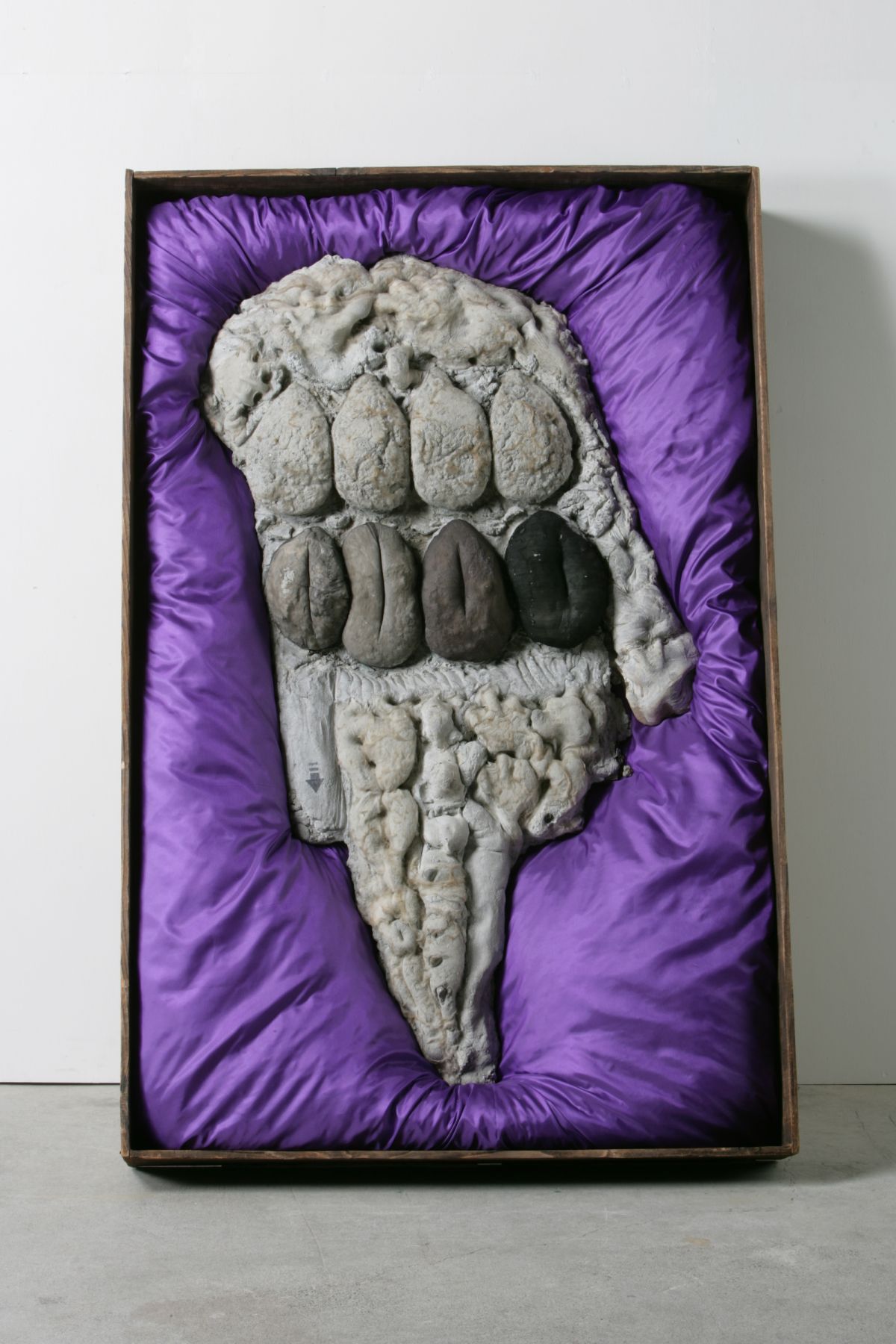
(Image: Einstein Between Matter’s Structure and Faintest Sound)
What you see is what you see, almost, or perhaps not quite.
It is a coffin or coffin-like box, the lining of which is a shiny fabric, dark in color
but highly reflective, a paradoxical color– paradoxical like death. Grotesque and, at the
same time, in some sense, realizing the classical canons of beauty.
One may see eight brains from a top view contained in a large white figure that
may be a body, misshapen and missing its head and feet, or it may be another brain, in a
side view, with the frontal cortex mostly lopped off and an exaggerated brain stem. It
may be a body trying to organize itself as a brain-driven creature or a brain, thinking
about brains or perhaps a succession of stills from a movie about a decaying brain,
darkening in time. Or the large white figure may be a mushroom cloud. One begins
always in ambiguity and uncertainty.
Einstein put an image in place of himself; Arakawa put himself or his active, living
body in the place of an image. It is the first event of a “thinking environment.” Arakawa
changes the scale of what it is to be known and to be acted upon.
Madeline put herself–her physical, active self–in the place of language.
In What the President Will Say and Do!!! she first exposes the inane
capriciousness of the Presidential language of power. Presidents speak in imperatives,
demanding the physically impossible or the logically impossible:
FILL THE OCEANS WITH COTTON!
ALWAYS PLACE INFINITE SYSTEMS FACE DOWN.
And in “All Men Are Sisters,” she undertakes the construction of an alternative
language: “Woman is the host. Man, the guest (guestess?). But the host has been too
amiable for too long.” Basing a language on a non-linguistic relationship creates a poetics
rather than a logic. Freed from logical symmetry, language becomes the medium of a
finite world which is created by the acts of its inhabitants. Instead of history progressing
toward the Absolute, there is an intensification of what can be spoken and known: for example, she writes, “Most women do not look like themselves; although many women
do assume the form or “woman,” some are men, other gas and electricity, and still others
are indistinguishable.”
In “A Sisterly Thesaural Dictionary,” the terms of a basic philosophic vocabulary
are constructed not from logical distinctions but from the multiple contingencies of puns,
rimes, oblique associations, shifting perspectives, and spontaneous intuition. It is a
radically concrete language. For example:
Existence: Employer
Uses Conveyor and Conversation Processes
Mercurial
Having recourse to. . .
Not for Everyone
Junta
Inexistence: Total Lack of Motivation
Orange Colored
It is a language in which the meanings of words are constructed individually, not
by reference to one another: knowing the meaning of “Existence” tells us nothing about
“Inexistence” or, if it does, not by any clear logic. Gins writes: “There could not have
been a woman who would have said, ‘Left side,’ ‘right side,’ then stuck to it. For a
woman, it is a question of at least seven sides, at least one for every hue.” Consequently,
women are not subject to the class logic of syllogisms: “One thing men haven’t realized
is that unlike them (all men are mortal), women do not die—This makes all the
difference—although some women, having been brow-beaten by sheer syllogistic brawn,
have at times pretended.”
Gins shows that language originates not in a primal distinction but in resourceful
constructions of many kinds; it is tested not in relation to its origin but in relation to its
use and the open field of creation and design that it makes possible.
Shortly after Arakawa’s death, Madeline made a list of “DIAGNOSES
CONTRIBUTORY TO A (POSSIBLY) DEFINITIVE DIFFERENTIAL DIAGNOSIS,” a
draft of which, printed on pink paper, she distributed to friends. She notes 37 possibilities that relate to the failure to diagnose the cause of Arakawa’s death. It is a serious and
funny indictment of the medical establishment. These are one-liners of outrage, pain and
utter grief. This is a sample.
AUTOMATICITY (AS A) DISORDER–RUNNING ON AUTOMATIC ILLNESS (SPECIES-WIDE)
BELONGING TO A SPECIES THAT HAS NOT YET FIGURED OUT HOW ITS
MEMBERS ARE ABLE TO DO WHAT THEY DO–SUCH AS WALK AND TALK
TOO MANY MISTAKES OF CERTAIN TYPES AND NOT ENOUGH OF OTHERS
INFLAMED RHYTHMS
AN INCOMPLETE SET OF DIRECTIONS FOR USE
RAGING MICROMECHANICAL DISCORDANCY
TOO FEW ARCHITECTURAL PROCEDURES IN PLACE
BLINKING FEMTOSECONDS (ONE QUADDRILLIONTH OF A SECOND / 10-15) ON THE BLINK
21ST CENTURY IGNORANCE DISORDER
21ST CENTURY IGNORANCE DISORDER
She repeats the line.
Medicine deals with the generalized person. Despite the numerous tests and
diagnostic procedures, the medicos knew little about the individual, Shusaku Arakawa.
Laughter too can be an expression of absolute grief. Madeline’s# brain laughing at
the medical mind, laughing at mind in general, or laughing at the generality of mind. This
is where the person leaves the scales of the cosmos and the society and enters the space to which the evolution of complex intelligence belongs.
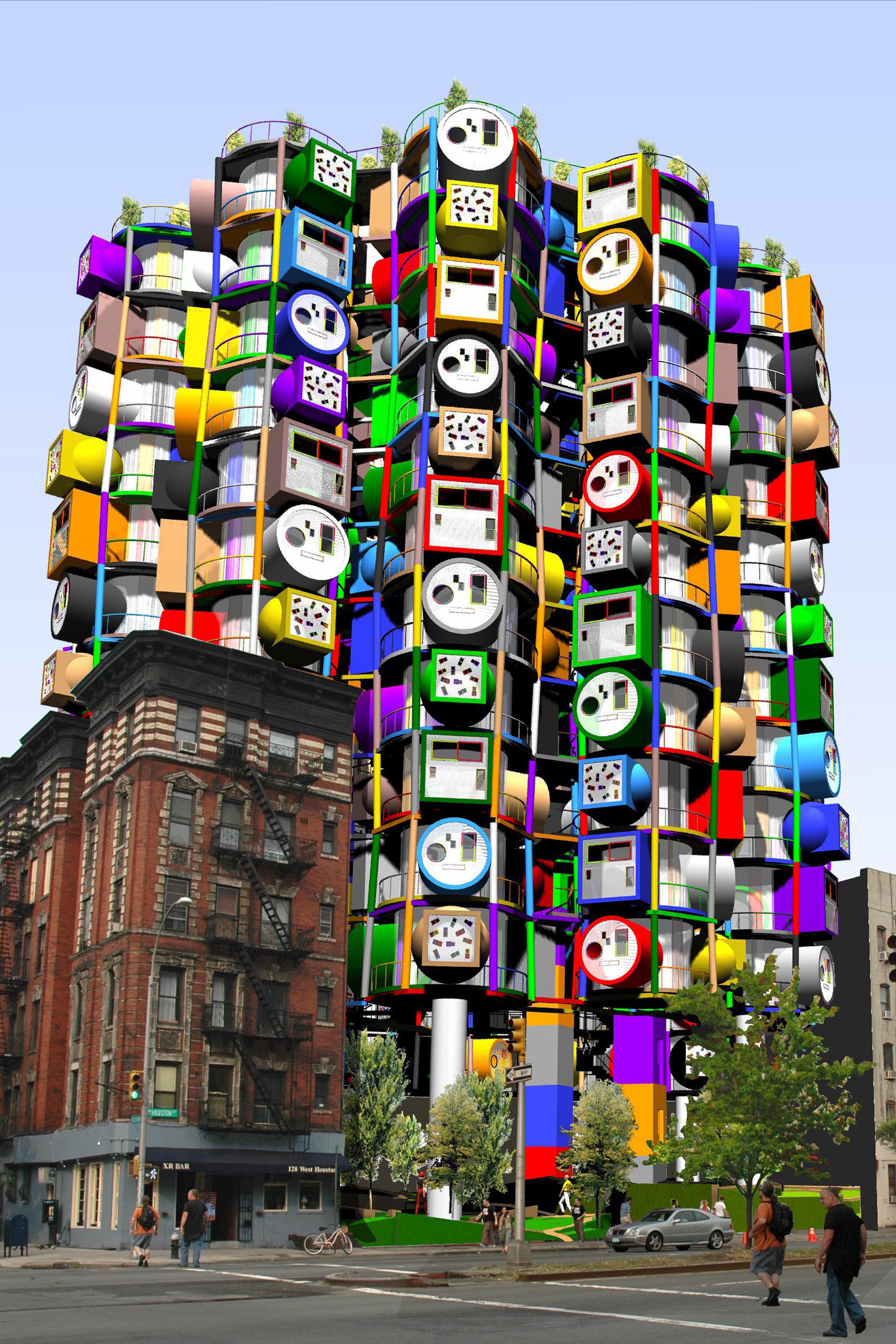
(Image: Hotel Reversible Destiny)
Madeline and Arakawa came to think of knowledge production as the research and
practice of thinking environments, keyed to the felicious survival of coordinated lives.
The aim of the work from the beginning was the creation of environments in which we
break the habits of life and death and take charge of our own Earthly evolution. They
spoke of the Hotel Reversible Destiny, one version of which they designed for the corner
of Houston and Sullivan Streets in Manhattan, next door to their home and studio, as an
evolution accelerator. Architecture, they said, was the new philosophy.
In The Mechanism of Meaning News, a one-off, one-page parodic tabloid, under
the subhead, “Species to get a new start,” we read: “Amazingly but rightly, the
construction of a place which can be used by human sensibility actively to evolve itself
has received official sanction. With this, a way will be provided for a species–this
species–to reconsider and rework prevailing conditions so as to direct its own evolving.”
They undertook the arduous task of clearing the grounds for another way of knowing.
The amazing fact is that more than a century and a half after the publication of The
Origin of Species, we still lack an epistemology and a technology of evolving earthly life
forms. This is the work to be done.
Madeline and Arakawa were culture workers / knowledge workers. They produced
a compendium of thinking through. Their work did not return the many to the one.
Disciplines proliferated in their hands: they were mechanics of meaning, scientists of the
mesocosm (scientists of viability), experimental logicians, cartologists of escape routes,
comedians of evolution, coordinologists, biotopologists, and procedural architects. These
are not disciplines of the system of the universe; they are zones defined by Earthly
possibilities.
There is not one logic or space or time; there are many, incohering together.
View also: Alan Prohm Presentation – Jondi Keane Presentation
 PROCEDURES Journal